Saturday, August 10, 2013

10 for 10: 10 Picture Books That Are New To Me


Here are my offerings for the 2013 edition of 10 for 10 Picture Books. Thank you, Cathy at Reflect and Refine and Mandy at Enjoy and Embrace Learning for hosting this fabulous event again this year! 

I hemmed and hawed and futzed and browsed and stewed and flip-flopped about the theme of this year's list. I finally decided that I just needed to DECIDE, and Maria gave me my unifying theme: 10 picture books that are new to me. I went to my Summer #bookaday shelf on GoodReads, and here are the 10 most recent picture books that I've read!

FICTION

Disney-Hyperion (June 25, 2013)
from the public library

I didn't love this book when I first read it, but it generated THREE reviews from the Dispatch Readers. Definitely has kid-appeal and clearly I need to take another look!


by Aaron Meshon
Atheneum Books for Young Readers (February 19, 2013)
purchased for my classroom

Did you every find the perfect book for last year's student?
That's this book, which features baseball in Japan and the US.
I'm hoping I have another student this coming year or in the future for whom this will be as perfect as it would have been for last year's student!


by Kate Banks
illustrated by Boris Kulikov
Farrar, Straus and Giroux (BYR); 1st edition (August 8, 2006)
purchased for my classroom

How did I miss this book? It will be perfect for launching word study!


NONFICTION
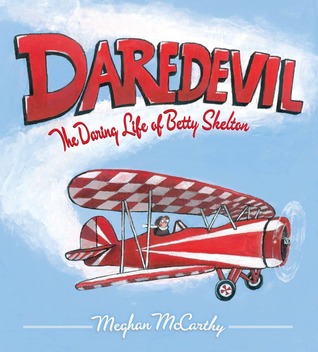


by Meghan McCarthy
Simon & Schuster/Paula Wiseman Books (June 4, 2013)
purchased for my classroom

I love Megan McCarthy's style, and Betty Shelton is the kind of person I want all of my students to know about. She had a big life full of adventures. She didn't let convention get in her way.


by Alice B. McGinty
illustrated by Thomas Gonzalez
Two Lions (April 2, 2013)
from the public library

This biography-in-freeverse of Gandhi focuses on one critical event in his life and in the history of India. Interesting to compare India under British rule to the American Colonies. Thomas Gonzales' illustrations (remember 14 Cows for America ?) are gorgeous.


by Melissa Stewart and Allen Young
illustrated by Nicole Wong
from the public library
Charlesbridge Pub Inc (August 2013)

Told in a "House That Jack Built" sort of way, readers learn about the interconnectedness of all kinds of factors that result in the link of monkeys to chocolate.
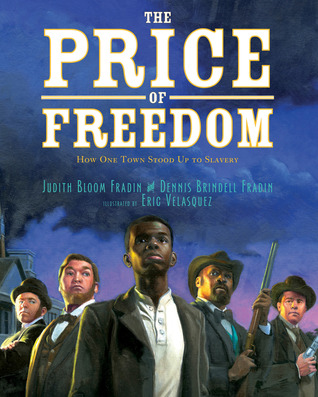


by Dennis Brindell Fradin and Judith Bloom Fradin
illustrated by Eric Velasquez
Walker Childrens (January 8, 2013)
purchased for my classroom

We can't provide children with too many examples of people who
stand up for good in the world, can we?


by Jennifer Berne
illustrated by Vlidamir Radunsky
Chronicle Books (April 23, 2013)
purchased for my classroom

Beautifully written, beautiful illustrations, and the inspiration to 
attend to one's imagination.


WORDLESS (or almost wordless)


by Bob Staake
Schwartz & Wade (April 9, 2013)
purchased for my classroom

A heartbreaking testimonial to the power of friendship.
Have you ever used a wordless book as your read aloud? Try this one.
Just sit in front of your students, turn the pages, and let them talk.


by Ã˜yvind Torseter
Enchanted Lion Books, coming August 27, 2013
review copy provided by the publisher

Enchanted Lion always has the most interesting books.
They publish books from around the world.
THE HOLE was originally published in Norway.

The covers are heavy cardboard, the pages are stiff cardstock, and there's
a hole
punched
all the way
through the book.

This is such a fascinating book that I'm going to give it a full-sized review on Monday.
If you're curious, come back for more!



Friday, August 09, 2013

Poetry Friday: The Space Between Breaths

by Hugh MacLeod at GapingVoid


The Space Between the Breaths We Take

Movie ticket, untorn;
popcorn box full.

Swimmers crouched;
pool still smooth blue glass.

Clean sheet of paper;
pencil, freshly sharpened, hovering.

Bus brakes hiss;
driver grasps the door handle.

© Mary Lee Hahn, 2013


My ophthalmologist asked me a very predictable and seasonal question last week when I was in for my yearly eye checkup: "Are you ready for school to start?" His wife is a teacher, and our conversation turned to the difference in pacing between a teacher's year and an ophthalmologist's. He drew the difference in the air with his hand -- ours like a roller coaster and his like I-70 in Eastern Colorado. He can't imagine living with the ups and downs of starting over again each year. And I can't imagine a career that stretches like a flat line from horizon to horizon. 

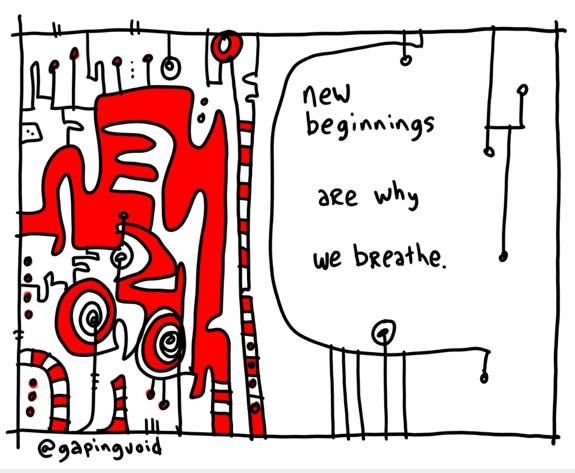
As if he were reading my mind, Hugh MacLeod sent me a 'toon to illustrate this: "New beginnings are why we breathe." If every new breath is a new beginning, teachers are living in that space between two breaths -- that space between when our "imaginary class" becomes the real students who'll live with us in our classrooms for the next nine months. That space between when the plans that are on paper come alive and grow into the living, changing curriculum that we will chase and try to pin down for the rest of the school year.

In my poem, I tried to capture other "spaces between," other moments filled with some of the same potential that teachers are living in for the next few days or weeks.


***ANNOUNCEMENT***
For Poetry Friday next week, on August 16th, we'll be visiting a new space, on Tumblr! Lisa invites you to Steps & Staircases. You can submit your contribution here: http://stepsandstaircases.tumblr.com/submit

In addition, Lisa also invites you to share something "close to your heart," sort of as another common side dish at our poetry potluck. It doesn't need to be poetry, it can just be something current you're really enjoying and would like to share with others. Thank you for participating!


Renee is hosting the Poetry Friday roundup today at No Water River.

Wednesday, August 07, 2013

Classroom Library-Some Photos and My Thinking Behind Them

Lots of my time this summer has been in the classroom thinking through my classroom library. It is not how I want it and I think I will be reorganizing through the first few weeks of school. But here is where I am right now. I am still working on the picture book section but that might come along with the kids once we start the year.  I'm not thrilled with where they are and how they fit on the shelves so I'm not sure how they'll work yet.  But the other sections seem to be coming along slowly. I always forget what a big job this is!

I had to do a lot of weeding moving from 4th grade to 3rd grade. Many of my books were just too complex to take up space and I needed to make room for more transitional books. I think I still have more to weed but will wait til I spend a few weeks getting to know the kids.

I have a large built in shelf that I am using for fiction--mostly series, favorite authors and chapter books.  There is a good variety and this is the largest part of the classroom library and the first thing you see when you walk in.  (5 of these across). This age is critical when it comes to finding authors, characters and series you love so this space is dedicated to that.

I've created baskets of authors who have both picture books and chapter books.  I am hoping students will find authors they love from primary grades. I also want to let them know that level doesn't matter --when you love an author, you love their work, regardless of level.  Doreen Cronin is funny whether they are picture books or chapter books. An important message at this age,  I think.

The Nonfiction section of the library is near our meeting area. It takes up a corner of the room. The books are organized into baskets by topic, series and author. There are also some random baskets/sections and a whole area of picture book biographies.

I've been working this year to find more nonfiction authors that I love and that my third graders will love. I am trying to create author baskets so that we come to know and love nonfiction authors in the same way we love fiction authors. There are so many great nonfiction authors I don't know well--so glad to be discovering them!

I've also spent time thinking about nonfiction series books that might be good for 3rd grade.  I know how important fiction series are for transitional readers. I am thinking the same is true for nonfiction when it comes to understanding text structures, organization. I have discovered so many great nonfiction series and am trying to make them visible to kids in the classroom.


Tuesday, August 06, 2013

Coming Soon! 10-for-10 X 2


Franki and I will both have 10-for-10 posts on Saturday, August 10. (more about the 10-for-10 Picture Books event here)

Between now and then, it's the usual mad scramble to be ready for the school year.

Monday, August 05, 2013

Solve It Your Way....then share it with the world

Today, please take a minute to visit Solve It Your Way!  and think about joining us this year as we celebrate all of the ways we solve problems. As an elementary classroom teacher, I've been facilitating math and science problem solving for as long as I can remember. The power of student learning has always been most evident during the share sessions--when students shared their thinking and their learning about the process of problem solving.

Early on in my science teaching, I found that my students were just going through the motions of science. So many "activities" took kids through the steps of answering a question but took all the mess and fun out of problem solving. So often the mess figuring out how to solve the problem, how to collect data and how to organize data was all part of a predetermined template. I learned early in my teaching career that if I took those templates away, kids created things well beyond what I could have imagined and became amazing scientists and mathematicians.

This year, I decided it would be fun to grow our classroom activity a bit and invite others into the rich conversations we will hopefully have. On the first day of each month, I'll post a new question at SOLVE IT YOUR WAY!. It will be a science/math question with lots of ways in for elementary students who are interested in some fun problem solving at home or in the classroom. You can share student work by linking to the post before the next question is posted. You can include individual student work, classroom charts, tables, graphs, photos, videos, slideshows...anything that comes from the problem solving. Checking back periodically, you can see how others outside of your classroom are approaching the problems.

 There is more information on the blog. And our August question is already posted! Please take a minute to visit the site and think about how your students might join in the conversation this year!

 You can also follow us on Twitter! @solveityourway

Sunday, August 04, 2013

July Mosaic


July flew by out the windows of an airplane and various cars: Colorado (photos 1-9), Kansas (10-11), Illinois (12), Maryland (15-20), and the Hocking Hills in S. OH (21-29). Brief glimpses of home can be seen in 13 (cat-in-the-box), 14 (107 point final word winning move WWF), 30 (baby eggplant in the school's plot of our community garden).

Click to view the set a bit larger, or go over to Flickr to check them out.


The Power of Habit...in the Classroom

The Power of Habit: Why We Do What We Do in Life and Business is one of those books that I can probably read over and over and over again in my lifetime. It was the one book I read during my concussion because when I was allowed to read in 10-15 minute spurts but unable to commit to a story, this was the perfect genre for me. I'm not even sure how I came across the book, but the idea of habits became instantly fascinating to me, especially at a time in my life when I had to give up most of the habits I knew so well.

At the Choice Literacy Writing Retreat last week, Brenda Power talked a lot about our writing habits and I began to reflect specifically on those and how the things I learned in The Power of Habit related to my life as a writer. The time at the retreat gave us all time to refocus on that aspect of our life.

When I got back home, I didn't have much down time before the work on my classroom began and I found myself realizing that after 25+ years of teaching, there are lots of habits built into what I do in getting ready for a new school year. This can be a good thing and it can be limiting. The thing this year is that after reading The Power of Habit, I am aware that I do have habits as a teacher and I imagine I have them during all times of the year. Just as Choice Words by Peter Johnston really pushed me to pay close attention to every word I speak in the classroom with children, I think The Power of Habit is making me very aware of those things I do without even thinking. Some of them make my teaching life very efficient.

Some of them are things I understand about young readers and learners that make my teaching work. My habits around setting up a classroom library are fascinating. The whole family is actually involved in those (although it is my habit, not theirs!). The ways in which I rethink, reorganize, label, replace, weed, etc. is pretty habitual each year. But there are other things I do every year that do not seem quite as purposeful.

 I am planning to monitor myself for those things I am doing to get ready for my year when my brain seems to be in auto-pilot. It is those things that deserve some thought. Am I doing them because I've always done them or because they are the right decision for this group of children right now? When you revisit a book like this at different times, different things stick. Because I revisited the book during the writing retreat, I was really able to look closely at my writing habits. But because it was fresh in my mind when I went into school to work the next day, my habits of teaching started to become clear to me. I think many of my habits of classroom teaching work well. I believe there are things that become habitual in a way that makes me efficient and effective.

But I also think that when my brain goes into auto-pilot, I just need to be aware--it will be my clue this year to make sure it is a habit that makes sense. Just a quick time to ask myself--does this still make sense or is it something I haven't rethought in a while--a habit I need to change? I think sometimes in our classrooms routines become habits as teachers and I am suddenly quite aware of that and looking forward to paying attention to those habits of language and routine in the classrooom.

 After reading Choice Words, I found myself reflecting constantly in the classroom, asking myself the same questions over and over. This year, I've created a little list of questions to keep in mind this year. 

What are my habits as a classroom teacher?
Which of those are good habits? Which are not?
Do I have habits in the ways in which I talk to students?
Do I have habits in the ways I set up the room?
Do I have habits that work?
Do I have habits that give students the wrong messages about learning?
Do I have habits I need to rethink?
Why do I do this? Is it something I've always done?
What would happen if I changed this habit?
What triggers this habit?

As someone who has remained a classroom teacher for 27 years, I know how important it is to stay thoughtful and purposeful. The Power of Habit has helped me to see why this is so important as a teacher. Habits matter and I think they do us lots of good. But if I am not aware of them, they can be the thing that keeps me from moving forward as a teacher and from looking at the group of children in front of me. Being aware of the power of habit in the classroom may help me change and grow in ways that better meets the needs of my students. Being aware will help me see those "things I've always done" in a new way and continue to grow and learn as a teacher.

Friday, August 02, 2013

Poetry Friday -- Habit

by Hugh MacLeod at Gaping Void


Like a Bad Habit

The ivy is overtaking the front bed.
It approaches the lamb’s ear insidiously.
It has overwhelmed a pair of stepping-stones.
Clearly, the whole driveway is within the scope of its ambition.

I admire its tenacity.

But my will 
will dominate.
My pruner and I
will reestablish
boundaries.

©Mary Lee Hahn, 2013


The theme of the recent Choice Literacy writing retreat was "Habits." We've all got 'em. Some are strong and productive, and the others eat our good intentions for breakfast.

I'm trying hard to fortify my morning habits of exercise and writing so that they are strong enough to withstand the tsunami known as teaching. I'll be keeping my best two hours for myself, but that leaves about 15 other waking hours for everyone and everything else. Seems fair, doesn't it? Check back in October and we'll see how I'm doing!

Poetry Friday is one of my favorite habits of all. Margaret has the roundup today at Reflections on the Teche.


Wednesday, July 31, 2013

Going Public

Wikimedia Commons photo by Justin Brockie
Raise your hand if you've ever been terrified to go public -- to introduce him to your parents, to speak in public, to start a blog?

And yet how often do we expect our students to share their ideas, try new things, or take a risk, all without fear or hesitation?

I have given myself a taste of my own medicine, and it's been good to remember how hard it is to do the things we ask our students to do all the time.

One of the gardeners I work with in our community garden is deaf. She had her hearing long enough to learn to speak, but she's never learned lip reading. So we've been getting by with her talking to us, and us writing to her. It's a functional solution, but not equitable, and definitely not inclusive.

I decided to learn to finger spell. Of course, "there's an app for that." I've been trying to spend a few minutes every day practicing with the app, and sometimes on my morning walk, I run through the alphabet or spell things I see.

But I was terrified to try it with my deaf friend. To be the rank beginner at the feet of the expert.

Finally, this past weekend, I jumped the hurdle. I told her I was learning. Her smile glowed and crinkles showed in the corners of her eyes. I asked for her patience as I got better. She nodded enthusiastically.

And that's all it took. I just had to get past my fear of failing and give it a try. She is thrilled that I am making an attempt to communicate with her on her terms, and she is patient, encouraging and helpful.

Just like we are with our students.


Monday, July 29, 2013

That First Read Aloud of the School Year....

Every year, I put a lot of thought into that first read aloud of the school year.  It is always my summer obsession.

On Twitter, the other day, I posed a question to a friend about a possible first read aloud.  Several others jumped into the conversation with suggestions for that first read aloud.  So many possibilities, but none feel quite right.  Last year, I wrote an article for Choice Literacy about my thinking behind that important first read aloud. For those of you that subscribe to the weekly Big Fresh from Choice Literacy, you may have seen it this week.  Spending my summers thinking about my first read aloud is not something new for me.  And in moving to a new grade level, I am finding myself doing even more thinking about it than usual.  I'm never sure quite what I am looking for, so the search often continues until that day right before the students arrive.

The Read Aloud routine is an important one in our classroom. It is an anchor for reading and conversations and community. It is a time when I work hard to make sure 100% of students are in the classroom and I protect that time from pullouts and interruptions.  It is important as students not only share a common story but we learn together how to think about and talk about stories in ways that change us--as readers and as people.

I know we'll read many picture books every day in the classroom, but in 3rd grade a chapter book read aloud is key as this transitional stage is a stage where children are learning to read longer books, stick with a plot, think across a longer text.  I know that a chapter book is not a chapter book is not a chapter book and I want that first one to be one with a plot simple enough for all students to follow but complex enough with some things worth talking about. I want to start those conversations about what readers do when reading longer books, but more importantly, I want to start those conversations about books and the way they often change our lives.

The choice of the first read aloud is even harder because I don't know my students. I don't know their reading histories and I don't know much about them as people.  I don't know if a child is going to walk in the door who who is suffering in some way.  Our community will not yet be strong enough during that first read aloud for a student to come to me to say, "I don't think I can listen to this story right now in my life." as they might do later in the year when they understand that this is one of the decisions readers make.

There are so many books I can read to kids and they would love, but kids loving a book is not enough for me.  I have found that kids love being read aloud to so much that most of them are going to love almost any book I read aloud and the year isn't long enough to read aloud that many books. So I have to choose a book for more reasons than just "kids will love it".  It has to give me lots as a teacher --each book has to grow them, as readers, as people and as a community of learners.

Even though read aloud time is an anchor in our classroom and I do lots of teaching, read aloud feels to the kids like that time of pure joy.  The book has to be so good that it naturally INVITES the conversations I  want to happen and that there are so many invitations for talk and thinking that the talk happens naturally.  I am looking for books that makes my "teacher work" during read aloud is almost invisible because the book pretty much does the work on its own.

Ideally, I'd love a book that none of the kids have read before. I value rereading but the first read aloud involves lots of kidwatching as I get to know each student and experiencing a new book can tell me so much.


So, it is nearly August 1 and I am still thinking.  I will probably still be thinking for a few more weeks. I started a Pinterest board to keep track of my own thinking--keeping track of the books on the top of my list for the moment and books that I want to keep in mind for the first few months of the school year.  I don't know if I'll stick with this list but it is a list of books I don't want to forget about yet. I know that after the first few days of school, when I know my kids and see how they respond to that first read aloud (whatever it may be) and I see the books they are reading and I start learning about who they are,  I will know the perfect book to choose for our second read aloud. But that first read aloud....it is never an easy decision!


Friday, July 26, 2013

Poetry Friday -- The Speed of Time

Photo by Mary Lee Hahn


A Teacher Turns the Calendar Page From July to August

It's the same feeling you get
just after you've nudged the sled 
over the shoulder 
of the hill.

Movement becomes momentum
and quickly shifts 
to catapulting and careening.

You relinquish control
and hold on 
for the ride.

©Mary Lee Hahn, 2013


Sherry has the Poetry Friday Roundup today at Semicolon.


Tuesday, July 23, 2013

Nerdy Book Club Post

I wrote a post for the Nerdy Book Club yesterday about my concussion and my weeks with no reading.  You can visit the Nerdy Book Club to read the post here

Monday, July 22, 2013

It's Monday! What Are You Reading? Online Edition


 This week, I found some online gems in my reading that I wanted to share.  Enjoy!

Pernille Ripp has a great post that is an important one to read as we start a new school year. We Must Be the First to Stop the Labels.

After having such a great day at Nerdcamp Battle Creek, I have spent lots of time reading everyone's blog reflections. Katherine Sokolowski has spent time doing a Nerdcamp Roundup on her blog and I've loved reading everyone's recap.

I loved Jen Scwanke's Big Fresh Lead, A Reader and Her Books.  As a fellow book hoarder, I could relate:-)

And this Mo Willems Interview was a fun read.

And, as always, Ruth Ayres puts things in perspective in this post It's Time to Get Ready for School.


Happy Monday and Happy Reading! 

Friday, July 19, 2013

Poetry Friday -- Minimalist

photo by Mary Lee Hahn


Just a note before we head out for a day of fly fishing.

Read the poem for today. Remember those who are gone and love harder those who are still here with you.

Then read the 20 quotes about writing in the sidebar (not sure why they sometimes are there briefly and then disappear behind the ads...how to make them stay visible???) and pick the one that is your favorite for today. Mine is:

“All good writing is swimming under water and holding your breath.”

—F. Scott Fitzgerald
That's the way it felt to write my Summer Poem Swap poem this week with my brain a (somewhat murky) lake of back to school planning. When the poem finally came, it was like that delicious first gulp of air after you've been under for almost too long.
Happy Poetry Friday! Jone has the roundup today at Check it Out.


Wednesday, July 17, 2013

#CyberPD--Who Owns the Learning?, Ch 5-end


Who Owns the Learning?: Preparing Students for Success in the Digital Age
by Alan November
Solution Tree (May 21, 2012)
I read the Kindle Edition


"Reflecting on my own education while growing up, 
I don't remember any of my tests. 
I don't remember any of my multiple-choice tests 
or my written answers. 
But I remember the experiences I had...
...what can we give kids that's an experience 
that they typically don't get...?" p. 86


Chapter 5 -- Job of global communicator and collaborator
Big idea for me: Students need to learn empathy. Global empathy as well as just plain understanding and appreciating other points of view.

Discussion Question #1 -- What kinds of opportunities can you imagine for enabling students to engage with authentic audiences around the world? 

  • Skyping with other schools and with authors...and perhaps with the international families of my students? Just learned last night on #5thChat about Mystery # Skypes and TodaysMeet. Both of these seem RICH with possibilities!
  • Working the Twitter feed for all it's worth. 
  • Participating in the Global Read Aloud.

Discussion Question #2 -- What barriers do you anticipate educators will face in guiding students in the role of global communicator and collaborator? 

The biggest barrier will be Me.

  • I have to guard against running out of time, energy, commitment, focus, and a willingness to brainstorm creative ways to access technology resources. 
  • I have to remember to start small, using authentic audiences in our own school district...maybe even our own building!
  • I have to choose projects wisely, then work backwards from the end result to make sure I've taught all the skills my students will need in order to be successful.


Chapter 6 -- Purposeful work, legacy of student contribution
The story of the student-written history text/wiki is fascinating. Leaving a legacy is as crucial as empathy. I had an amazing interim principal once upon a time (you know who I'm talking about, some of you). His tagline on all written and most verbal communications was "Leave a legacy." The hallways in the new wing of our building (built during his term with us) are named Legacy Lane. Through his constant use of that word, he made me think about the value and importance of all I do in my classroom and our school. I think the idea of taking student work to the Legacy Level can be a ongoing conversation from day one. "What can come of this work we are doing that will be of lasting importance? Of use to someone else?" Thinking about the legacy piece will naturally tie into teaching empathy. (Hmm...this is pretty fascinating. You are witnessing ideas being born as I type...I'm getting really excited about this!!) I recently had an afternoon of conversation with some of my #LivePD pals. We kept wrapping back around to the idea of "Who will be the audience?" Seems like if students are involved in conversations about leaving a legacy, they are also determining the audience for the work they'll be doing. So they won't just be shouting into Cyberspace and hoping someone will respond. (Hmm...it's all coming together nicely...) And if we're considering legacy, we've got purpose covered, too! (Hmm...)


Discussion Question #1 What opportunities can you identify for incorporating multiple student jobs into your classroom activities? 

The answer is Yes.  (need time to think and plan)

Discussion Question #2 How could you help your students create an educational legacy that would outlast their own student experiences?

The answer is Yes. While I'm hoping that it's not just one thing and that it comes as much from them as from me, I do have one idea I'd like to float to my students and to the staff of my school: We need to take our Multiculturalism on the road to other schools whose classes aren't as international as ours. We need to take our authentic Multicultural Day out to other schools that have a fake one put on by their PTO.

Discussion Question #4  How would you structure yearlong collaboration with colleagues beyond your classroom to add value to your students' learning experiences?

See answer to #1.  (also got a good start on this during #LivePD with Karen, Maria and Cathy)


Laura Komos (Ruminate and Invigorate) is hosting today's conversation about WHO OWNS THE LEARNING? Thank you to her, to Jill Fisch (My Primary Passion), and to Cathy (Reflect and Refine) and for bringing us together to have these important conversations. Looking forward to the Twitter Chat!

Tuesday, July 16, 2013

The Meanest Birthday Girl by Josh Schneider

I've spent lots of time this summer catching up on series books that I think my new third graders will be reading when school starts next month.  Catching up on these transitional books is key to supporting their reading development. I'm also looking for stand-alone books that help readers understand the power of story and that help them build conversation to understand character, see the world differently, and laugh and learn together.  3rd grade is a challenging one when it comes to book choice because it is tempting to choose books that are just beyond what kids are ready for so they don't quite understand them.  They are 8 year-olds so their life experiences are not quite ready for the depth of some middle grade novels. And I am a firm believer that if we give kids great books too early, we take away the joy of experiencing an amazing book later, when they are able to fully enjoy and love it.  But, I also know that third graders are brilliant people who have lots to say and need books to help them think through life. It's just that finding books that match the stage of life is not as easy as it appears.

But, I found one this weekend that I think is perfect!  The Meanest Birthday Girlby Josh Schneider seems to be the perfect book for early third grade. I am thinking it will make a great read aloud and one that we can revisit and discuss. I am not thinking it is one with huge depth but there is depth and humor that will provide for conversation and kids will need to infer lots to fully understand the message here.

Dana is the birthday girl in this story. And because it is her birthday, she can do whatever she wants. So she pinches, steals desserts from others' lunches, and calls people names.  At the end of the day, she has a birthday party and gets presents and this is where the fun begins.

The book is a short chapter book (48 pages total). The illustrations add to the fun of the book and the characters are some of my favorites.

I think this book was written for young children in that they will have to really think to understand the message but they will love the fact that they "get it".  Them message is a good one and there will be lots to talk about when it comes to choices, kindness, and how we treat each others.  Lots to love about this book.

And, Anthony? Well, he might be one of my favorite new characters ever. Even though he only says a few words in the whole book.

Monday, July 15, 2013

Notice and Note (With CHICKENHARE)


Notice and Note: Strategies for Close Reading
by Kylene Beers and Robert Probst
Heinemann, 2013

In my post last Thursday, I shared my plan to search for the signposts in everything I read/viewed for the rest of the summer. What's that quote about roads that are paved with good intentions? What a ridiculous goal that was!! And what a good reminder: EVERY text does not need a close reading! Note to self and others: don't overdo the signposts, or they will kill a love of reading as surely as any packet of worksheets.

I had success last week using the Notice and Note signposts with DON'T FEED THE BOY, a middle grade realistic fiction novel by Irene Latham. I've been on a graphic novel-reading binge for a couple of days, so I got to wondering if I could find the signposts in a graphic novel. After all, many (if not most) of my students will choose a graphic novel over any other genre or format any day.

Lo and behold, they were there. I had to think differently about them at times, finding them in characters' facial expressions or in the illustrations. But they were there. And I didn't try finding them in a straight-forward, traditional-narrative sort of graphic novel. The next one up on my pile was fantasy with oddball random characters and a storyline that makes you feel like you've been dropped into the middle of the story. (Just checked online. Although this book is not identified as a part of a series, it might be the third book. That would explain a lot about the dropped-in feeling.)


by Chris Grine
Scholastic/GRAPHIX (February 1, 2013)

In this story, a chicken-legged rabbit and a bearded box turtle team up with the ghost of a goat to defeat the evil guy who keeps killing his pets and stuffing them so that they can't run away from him. (Think "willing suspension of disbelief...")

p. 9 What the butler says and how the evil guy answers don't match. CONTRAST AND CONTRADICTION (with a bit of irony and sarcasm thrown in)
p. 11 The other evil guy who kidnapped Chickenhare and Abe (the turtle) unwittingly gives the duo information that will help them to escape. AHA MOMENT (for characters and the reader, who should be predicting like mad when this happens!)
p. 66 The ghost of the goat shows up again. AGAIN AND AGAIN
p. 79 " 'Forty years ago...' " MEMORY MOMENT
p. 97 Interchange of questions between Chickenhare and the ghost of the goat. TOUGH QUESTIONS
p. 98 The ghost of the goat comes as close as it gets to giving WORDS OF THE WISER
p. 139 The visual clue in the picture gives the reader an AHA MOMENT when they realize how Chickenhare and the goat are going to trick the evil guy.
p. 157 The faces of Chickenhare and Abe are happy that they are continuing their journey. The faces of their two companions are not happy. CONTRAST AND CONTRADICTION


Saturday, July 13, 2013

#nerdcampbc-An Amazing Day!!


There are a few professional days each year that I live for.  Conferences that I look forward to as anchors to my year--where I go to learn, reconnect with friends, and re-energize. I can't imagine being a teacher without these few events each year. NCTE, the Dublin Literacy Conference, the Literacy Connection, All Write. They have become part of who I am.  This week, I added a new anchor to my list--#nerdcampbc.  For those of you that missed out on #nerdcampbc, this is the brainchild of Colby Sharp and you can learn more about it on the nerdcamp site.

Thank goodness Sherry told me about #nerdcamp!
Most of you know that I have pretty much been tethered to my house for the last few months due to a concussion and that #nerdcampbc was my first big professional outing.  I had a few hesitations this week as I realized how much I have to do to get ready for school in the fall and I feel pretty behind having had to take so much time off.  And then there were the bigger issues of wearing something other than yoga pants and putting on make-up and earrings :-).  But I could not pass up the chance to be part of this event.  Seeing all of my tweeps and learning together was something I had been looking forward to since Sherry had mentioned it to me. And I am so glad I attended! What a great day!


Colby and Donalyn at dinner Wednesday night.
From the moment I got in the car with my Car PD girls--Cathy Mere, Karen Terlecky, Stephanie Shouldis, and Katie Strawser, I knew it was going to be a fabulous two days. Although we were not so talented at directions, I learned so much just talking and learning from them on the trip. So much great informal talk.  Even through a few possible tornado warnings, we arrived in Battle Creek in time for dinner with a great group of people. It was great to connect with old friends and to meet new ones. Laughing together and talking books started right away.


Alaina explains the board!
Colby, Alaina and the #nerdcamp team started the camp bright and early Thursday morning. Most of us had never been to an Edcamp which I thought was a huge tribute to the planning team.  We attended because we trusted them.  We had no idea what we were attending but we loved the team and jumped on board because we knew they would plan something amazing.

We built the sessions that morning and it was such a hard decision as to which sessions to attend. Travis at 100 Scope Notes has a great post on how the day worked if you've never attended an Edcamp. I must say, the energy in the room was amazing. It was just a huge party of excitement about how it would turn out. It felt like a big game show, with Colby as our host. I loved watching the process as new sessions were added to the board and the program came together. And I love that Colby had this Literacy Edcamp idea at all--the idea of Edcamp with a Literacy focus made it all the more fun to watch unfold.

I attended four great sessions. I learned more about Evernote for record keeping and lesson planning from Cathy Mere, Karen Terlecky Alaina Sharp in Session A2.  I learned about Motivating Reading and Writing Through Technology from Donalyn Miller and Suzanne Gibbs in Session B2. In Session 3 I learned about Sister Classrooms from Brian Wyzlic and Jillian Heise. (We also continued the #hatback conversation here..). And in Session 4, I learned about Battle of the Books and One Book, One School from Sherry Gick  and Kathy Burnette.

A great thing about #nerdcamp is that all the sessions had a notetaker so you can access the notes of sessions you attended or sessions you could not attend right from the Google Doc/Idea Board. I'm pretty sure I'll be exploring the thinking for weeks.  It was a truly great set up for continuing the conversation and it is a great resource for those who could not attend #nerdcamp.

The Twitter hashtag is another great way to join in on the conversation that is still going on (#nerdcampbc).


And then there were prizes!! Such a great way to end a great day!
\
The Real Boy!!


Finally,  it was time to say goodbye to Old Friends and New Friends! No one seemed tired as everyone was so happy and energized and already looking forward to next year's #nerdcamp!


#Nerdcampbc is definitely an event I will try to plan my future summers around because I never want to miss it.  It was a day that made me happy.  So many great new friends. So much great learning. A perfect summer day in my opinion.

THANK YOU, #nerdcampbc Team!

Thank You, #nerdcampbc Team!


Friday, July 12, 2013

Poetry Friday -- Gardening

Creative Commons Photo by Mary Lee Hahn


RECLAMATION AND EXALTATION

The air is cool;
sun sits low behind the trees.

My tea is hot;
one last sip before I start.

The garden is large;
weeds are plentiful and vigorous.

*   *   *

I turn my head slowly;
two hummingbirds argue over coneflowers.

I sit back on my heels;
chickadees and bees ignore me.

I stand and stretch;
the air is hot, the tea is cold, the garden is weeded.


©Mary Lee Hahn, 2013


Michelle has the Poetry Friday roundup today at Today's Little Ditty.